ForeSplat: Optimization-Aware Foresight for Feed-Forward 3D Gaussian Splatting

1ShanghaiTech University 2GGU Technology 3Stereye
*Indicates Equal Contribution
Indicates Corresponding Author
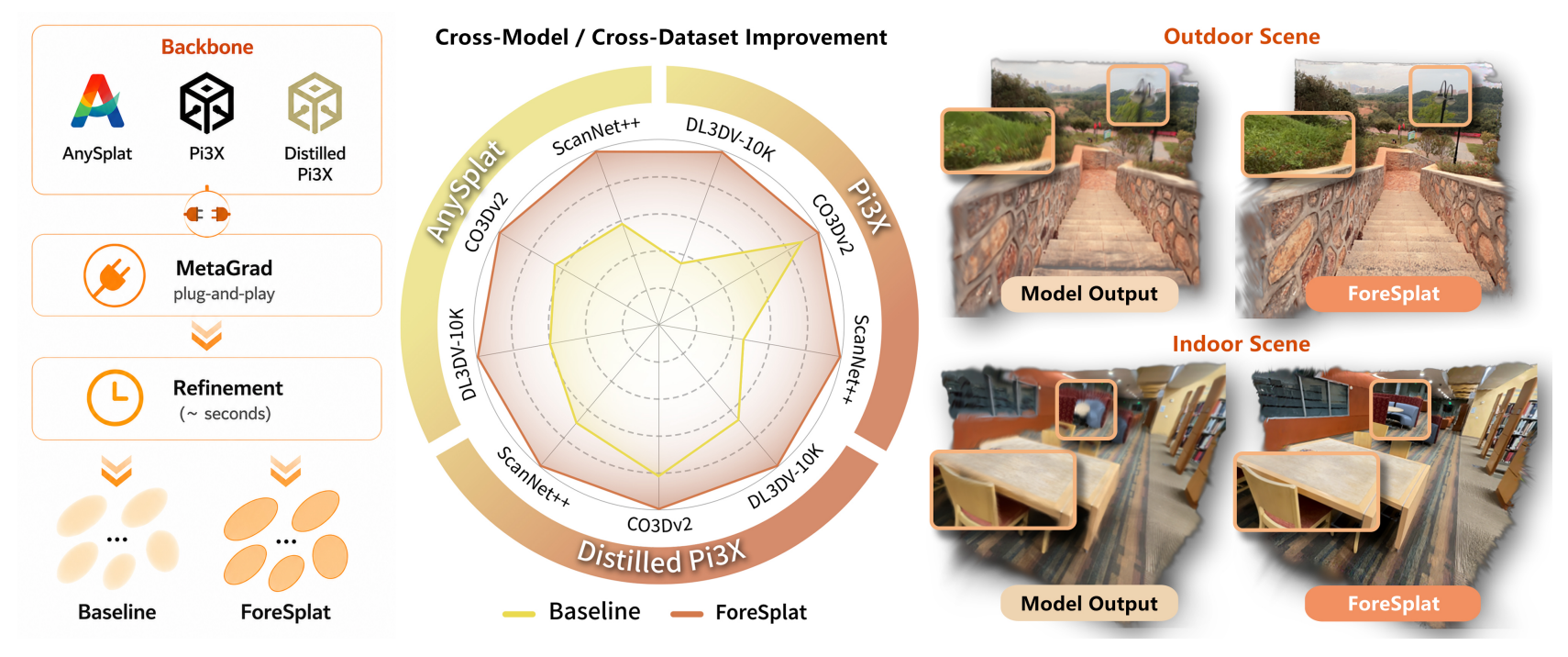
ForeSplat teaser

ForeSplat equips feed-forward 3D Gaussian Splatting with an optimization-aware training objective, making its predictions amenable to rapid per-scene refinement. We showcase its generality by attaching it to diverse backbones.

Abstract

Feed-forward 3D Gaussian Splatting (3DGS) models offer fast single-pass reconstruction, but scaling them to match per-scene optimization quality is fundamentally hindered by the scarcity of large-scale 3D annotations. A practical compromise is predict-then-refine, where post-prediction optimization compensates for the limited capacity of the feed-forward network. However, standard feed-forward 3DGS is trained solely for zero-step rendering error, ignoring whether its output constitutes a good initialization for the downstream optimizer. We present ForeSplat, an optimization-aware training framework that equips feed-forward 3DGS models with a meta-gradient assisted training rule (MetaGrad). By unrolling a short refinement trajectory and back-propagating aggregated first-order gradients as a surrogate optimization-aware signal, MetaGrad bypasses costly higher-order differentiation, offloads part of the scene-modeling burden to the optimizer, and reduces capacity pressure on the feed-forward model. This fine-tuning adds no inference cost and enables high-quality reconstruction within seconds after a few refinement steps. We instantiate ForeSplat on diverse prevailing backbones. Across all tested architectures, a ForeSplat-trained initialization converges in fewer refinement steps and reaches a higher peak reconstruction quality than its vanilla counterpart, even fully converged. The framework consistently bridges the gap between amortized prediction and per-scene optimization, establishing a practical path toward lightweight, high-fidelity 3D reconstruction.
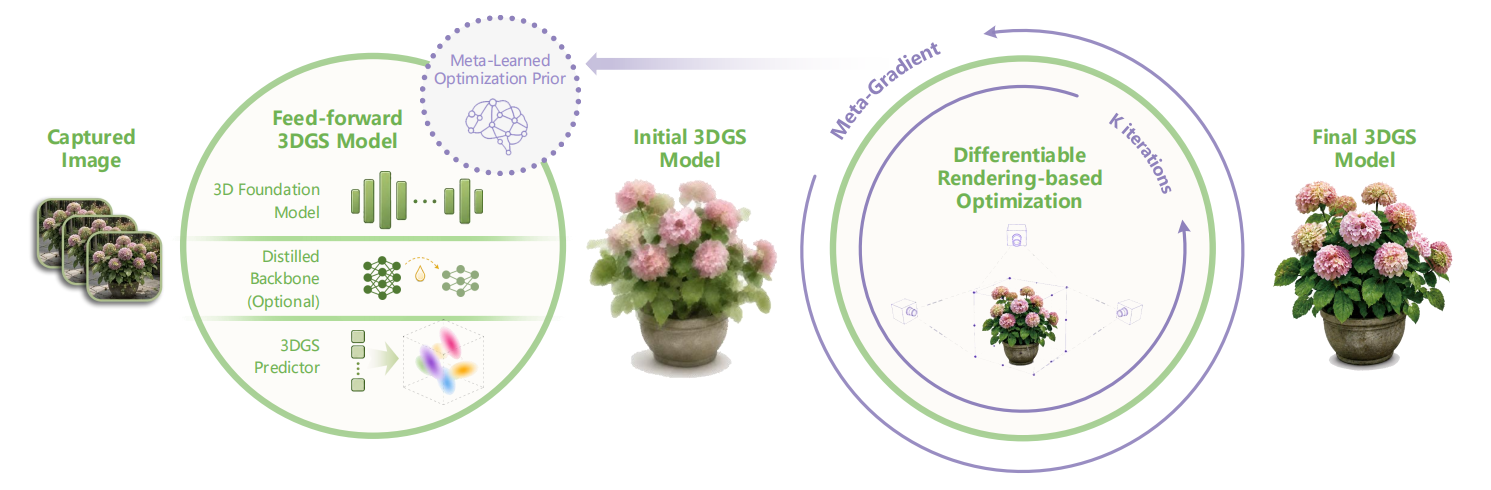
Method

ForeSplat pipeline overview

Overview of ForeSplat. Given a set of uncalibrated input images, a feed-forward 3DGS model predicts initial Gaussians. ForeSplat then unrolls a short refinement trajectory, samples anchor states, and back-propagates the resulting first-order meta-gradients through the Gaussian prediction head. This produces optimization-aware initializations without altering the inference-time pipeline.

Experimental Results

Computational cost of the different training stages used in our experiments.
Method Backbone Trainable part GPU hours
w/o MetaGrad AnySplat1 Backbone, GS head 768.00
Pi3X GS head 46.22
Distill Pi3X Backbone, GS head 745.86
MetaGrad AnySplat GS head 6.86
Pi3X GS head 6.11
Distill Pi3X GS head 4.41
EcoSplat GS head 1.69
F4Splat GS head 6.98

1 Results from original paper.

Quantitative post-optimization results
Method PSNR ↑ SSIM ↑ LPIPS ↓ ≈ Steps ↓
02005001k2k 02005001k2k 02005001k2k 5001k2k
AnySplat [TOG'25]448×448
Vanilla21.6626.1726.8827.0227.030.7360.8380.8440.8390.8330.2540.1660.1530.1560.163
+ MetaGrad15.7825.7627.1027.6227.760.5420.8200.8470.8500.8470.5030.2190.1680.1510.148400450450
InstantSplat18.7723.5525.2025.6325.910.6400.7320.7710.7790.7710.3890.2360.2020.1930.194
Pi3X[ICLR'26]224×224
Vanilla21.2923.8824.4824.8624.970.6750.7750.7820.7840.7770.2310.1680.1640.1650.171
+ MetaGrad18.8423.9224.9225.4425.810.5620.7620.7830.7880.7920.3650.1930.1670.1580.153300500500
Distill Pi3X[ICLR'26]224×224
Vanilla20.3022.8923.3123.5023.610.5970.7170.7260.7290.7270.2870.1750.1720.1750.180
+ MetaGrad19.4423.0223.6023.8624.050.5800.7210.7370.7420.7430.3260.1810.1700.1680.169300400500
EcoSplat[CVPR'26]256×256
Vanilla20.9822.8823.2023.3023.320.6250.7110.7130.7100.7060.3080.2610.2550.2540.255
+ MetaGrad20.2023.0523.4123.5123.480.5980.7170.7190.7160.7110.3370.2640.2530.2500.249300400400
F4Splat[ECCV'26]256×256
Vanilla23.6226.9127.6727.9628.100.7550.8450.8510.8490.8470.1790.1250.1180.1180.120
+ MetaGrad21.5427.1127.9528.2628.460.7010.8490.8550.8560.8550.2480.1310.1200.1160.115300500550

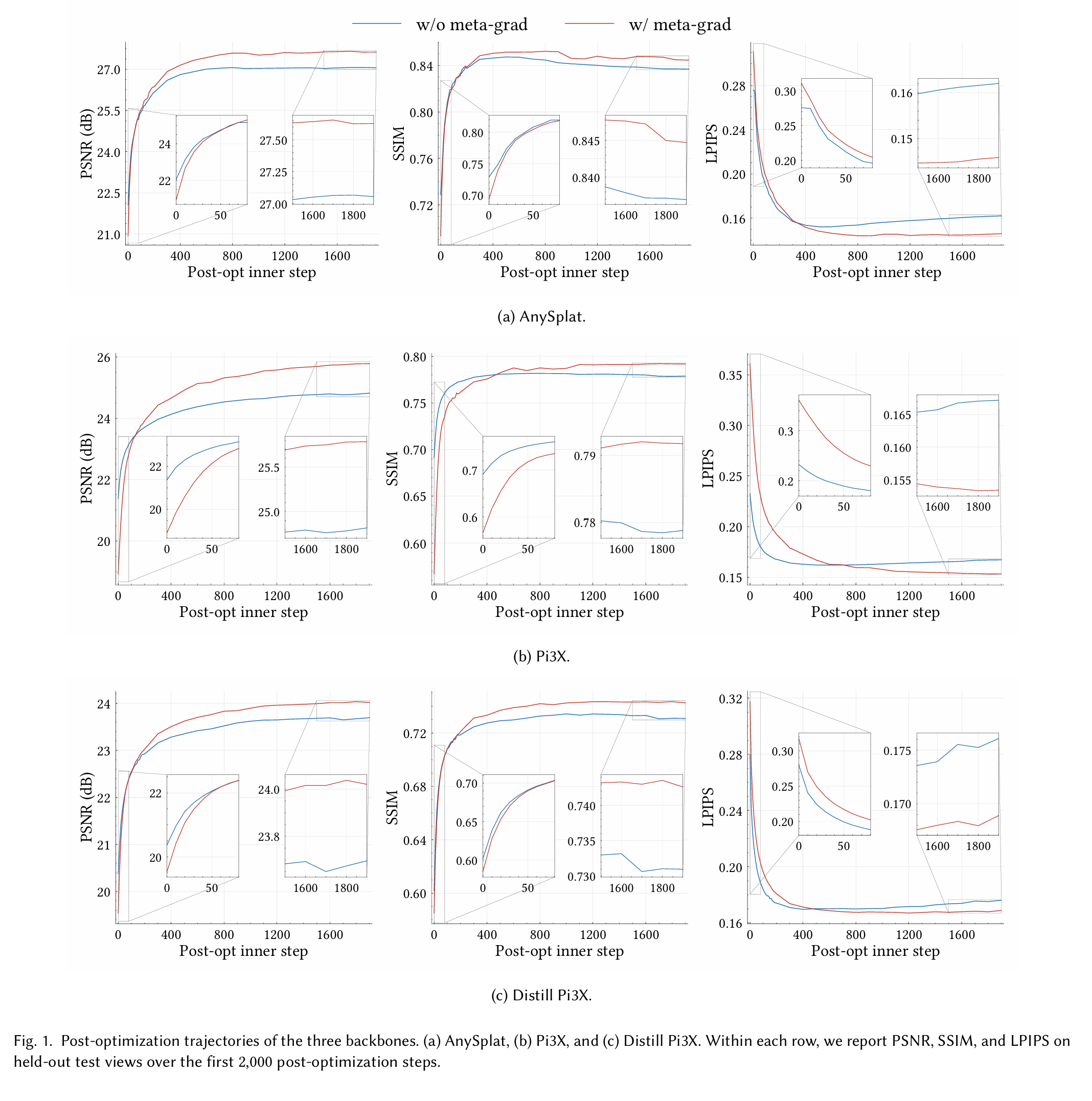
Quantitative post-optimization results. PSNR, SSIM, and LPIPS are reported on the same held-out evaluation views over 0-2000 refinement steps. For each MetaGrad-trained model, ≈ denotes the number of refinement steps required to match the PSNR of its vanilla counterpart at each budget. All evaluations are conducted with their officially released codes.

Ablation of λ on the AnySplat backbone.
Method PSNR ↑
0 200 500 1k 2k
baseline 21.9026.1626.9127.0327.05
λ = 1.00 21.6626.1726.8827.0227.03
λ = 0.75 21.0926.3127.1627.4127.48
λ = 0.50 20.7026.3627.3227.6027.68
λ = 0.25 20.9826.0726.8727.1327.22
λ = 0.00 15.7825.7627.1027.6227.76

Ablation of λ on the AnySplat backbone.

Ablation of Δ on the AnySplat backbone.
Method PSNR ↑ GPU Hours
0 200 500 1k 2k
Baseline 21.9026.1626.9127.0327.05
Vanilla 21.6626.1726.8827.0227.030.98
Reptile 22.5326.1626.8826.9727.008.05
Δ = 1 21.3226.1126.8627.1327.2022.37
Δ = 20 21.0926.1526.9227.1927.286.54
Δ = 40 20.7026.3627.3227.6027.686.86
Δ = 80 21.2026.1126.9127.1727.196.75

Ablation of Δ on the AnySplat backbone. We report PSNR after 0–2k refinement steps; Baseline is the original model, Vanilla is supervised fine-tuning without MetaGrad, and Reptile follows the corresponding meta-learning baseline.

Post-optimization trajectories for the evaluated backbones

Gallery

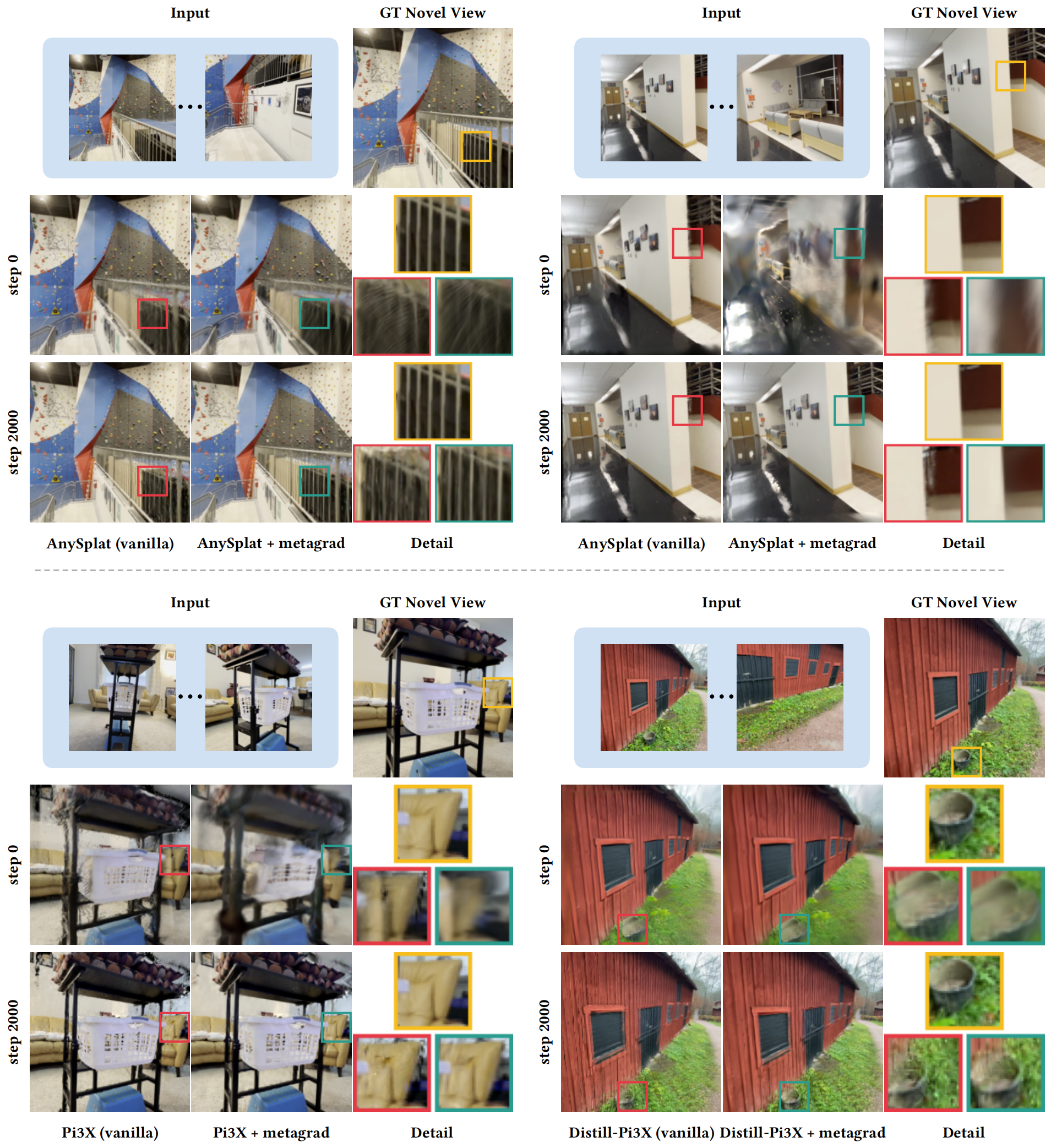
Qualitative comparison before and after post-optimization

Qualitative comparison of vanilla and MetaGrad before and after post-optimization. MetaGrad starts from weaker zero-step renderings, yet after post-optimization, it consistently attains cleaner structure and sharper appearance than vanilla, demonstrating a more post-optimization-friendly initialization.

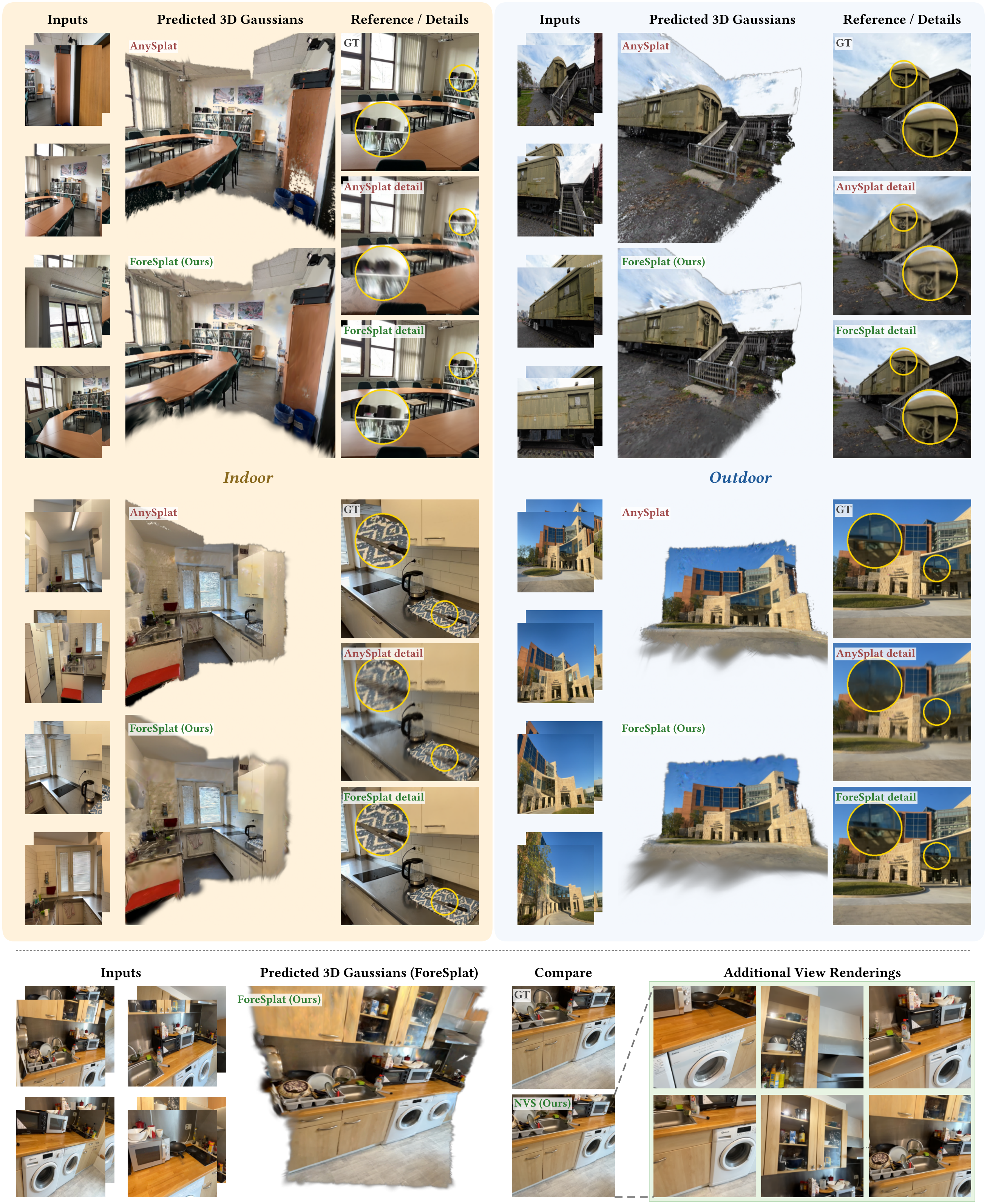
Qualitative comparison of 3D reconstruction quality

Qualitative comparison of 3D reconstruction quality between AnySplat and our ForeSplat (ours). The upper block shows two indoor (left) and two outdoor (right) scene. The bottom row showcases a single scene rendered from multiple novel viewpoints by our method.

BibTeX

@misc{li2026foresplatoptimizationawareforesightfeedforward,
      title={ForeSplat: Optimization-Aware Foresight for Feed-Forward 3D Gaussian Splatting}, 
      author={Yuke Li and Weihang Liu and Cheng Zhang and Yuefeng Zhang and Jiadi Cui and Zixuan Wang and Junran Ding and Haoyu Wu and Yujiao Shi and Jingyi Yu and Xin Lou},
      year={2026},
      eprint={2605.22020},
      archivePrefix={arXiv},
      primaryClass={cs.CV},
      url={https://arxiv.org/abs/2605.22020}, 
}